Showing posts with label Transocean Tours. Show all posts

27 April 2019

Astor in Helsinki, 27 April 2019

The 2019 cruise season in Helsinki started today (and is expected to break passenger records again), with CMV/Transocean Kreuzfahrten's Astor being the first ship of the season. Since the weather was unusually warm and sunny for the season, I thought I'd head out to take some photos. And it was high time, too, as the last time the Astor appeared in this blog was way back in 2011!

Astor

IMO 8506373
Former names: Astor, Fyodor Dostoyevskiy
Built 1987, HDW Kiel, West Germany
Tonnage 21 000 GT
Length 176,50 m
Width 22,61 m
Draugth 5,80 m
578 passengers (650 passengers maximum)
4 Sulzer-Wärtsilä diesels, combined 15 400 kW
2 propellers
1 bow thrusters
Speed 16,5 knots (18 knots maximum)

The history of the Astor is rather fascinating: the ship built in 1987 at Howaldtswerke-Deutsche Werft (HDW) in Kiel, as the last purpose-built ocean liner to be completed before the Queen Mary 2, although the Astor never sailed as such.

The Astor had been ordered by Safmarine in 1985 to replace an earlier ship (also named Astor, at the time of writing facing an uncertain future as the Pearl II, having been featured in this blog as the Saga Pearl II). The second Astor was to be essentially identical to the first, but slightly larger and with more powerful engines to be better suited for the Southampton-Cape Town -route. However, before the second Astor could ever be completed, in 1986 Safmarine decided to abandon the liner service and the under-construction Astor was sold to the Marlan Corporation.

The Astor was completed in early 1987 and placed on cruises around the Caribbean. In late 1988 the was sold to the Soviet Union's Black Sea Shipping Company and renamed Fyodor Dostoyevskiy (or however you wish to translitterate Фёдор Достоевский – the lack of consistent Russian cyrillic to English translitteration rules is a source of constant irritation to me). For a little over a year the ship was chartered to Transocean Tours, before being chartered for five years to Neckermann Seereisen. At the end of that charter in 1995 the ship reverted to its original name Astor as was chartered to Aquamarin. The next year the Astor was (again) chartered to Transocean Tours.

In 2009, the Astor became Transocean's only ship, and in 2013 the company (the name of which had been amended to Transocean Kreuzfahrten in the interim) was sold to Cruise & Maritime Voyages. During the summers, the ship operates European cruises for the German market under the Transocean brand name, and during the (northern hemisphere) winter it has cruised for the Australian market under the CMV. This, however, is due to cease now that CMV has taken delivery of the larger Vasco da Gama.

The photos below show the Astor at, and departing from, Helsinki Eteläsatama (south harbour) in the evening of 27 April 2019. Photographed from Kauppatori. As per the usual practice, click on the images to see them in larger size.

No unsuspecting offspring or spouses were harmed in the making of this photo.
The Astor and our charmingly small ferris wheel.
You get interesting photobombs when taking photos from next to the quay for local ferries, such as the lovely 1952-vintage Suokki.
The Astor took its sweet time actually getting anywhere – I guess they weren't in a hurry!
The weather attracted a lot of people to spectate, and people with boats were out in force, too.
The rest of the aft views were rubbish as this side of the ship was in the shade.
Kships will return.

20 December 2011

Astor in Helsinki, 4 September 2011

Astor

IMO 8506373
Former names: Astor, Feodor Dostoevskiy
Built 1987, HDW Kiel, West Germany
Tonnage 21 000 GT
Length 176,50 m
Width 22,61 m
Draugth 5,80 m
578 passengers (650 passengers maximum)
4 Sulzer-Wärtsilä diesels, combined 15 400 kW
2 propellers
1 bow thrusters
Speed 16,5 knots (18 knots maximum)

The Astor is currently the only ship belonging to Transocean Cruises (previously Transocean Tours), after the company was reorganized in 2009 following insolvency. The ship in itself is utterly fascinating: built in 1987 at Howaldtswerke-Deutsche Werft (HDW) in Kiel, she was the last purpose-built ocean liner to be completed before the Queen Mary 2, although she never sailed as such.

The Astor had been ordered by Safmarine in 1985 to replace an earlier ship (also named Astor, at the time of writing sailing as Saga Cruises' Saga Pearl II. For more details see the 1st entry on the Saga Pearl II). The second Astor was to be essentially identical to the first, but slightly larger and with more powerful engines to make her better suited for the Southampton-Cape Town -route. However, before the second Astor could ever be completed, in 1986 Safmarine decided to abandon the liner service and the under-construction Astor was sold to the Marlan Corporation.

The Astor was completed in early 1987 and placed on cruises around the Caribbean. In late 1988 she was sold to the Soviet Union's Black Sea Shipping Company and renamed Feodor Dostoevskiy. For a little over a year she was chartered to Transocean Tours, before being chartered for five years to Neckermann Seereisen. At the end of that charter in 1995 the ship reverted to her original name Astor as was chartered to Aquamarin. The next year she was (again) chartered to Transocean Tours. In 2002-2008 she was joined in the Transocean fleet by her elder semi-sister, which was now named Astoria.

Today the Astor remains in service with Transocean Cruises, making cruises aimed at the German market.

The photographs below show the Astor at Helsinki South Harbour and passing though the Kustaanmiekka strait departing Helsinki on 4 September 2011. Click on the images to see them in larger size.

Transocean Tours used a lighter, turquise shade on the hull and funnel markings, but after the company became Transocean Cruises in 2009, these were changed to a darker, more nautical shade of blue seen here.
In 2010 the Astor has been given additional structures on the forwards superstructure (below the bridge), which make her less good-looking, but at least make it easier to tell her apart from her near-sister Saga Pearl II.
And then the usual set of photos showing the ship passing through the Kustaanmiekka strait.
They don't make ships as sleek as this anymore, do they? Now with funnels quite to big and phallic.
The ramparts and sunset reflections.
Does it really matter what I'm writing here? Does anyone read these captions anyway?
On a practical note, I seem to be getting royally busy around and after Christmas and hence it is possible that this will be the last update to this blog for this year. So if there are no further updates I'm not dead, just enjoying the company of relatives and friends.

10 January 2011

Marco Polo, 22 August 2008

Marco Polo

IMO 6417097
Built 1965, VEB Mathias-Thesen-Werft Wismar, East Germany
Tonnage 22 080 GT
Length 176,28 m
Width 23,55 m
Draught 8,17 m
915 passengers
2 Sulzer-Cegielski diesels, combined 15 447 kW
2 propellers
1 bow thruster
Speed 16,5 knots

Starting off the new year (somewhat belatedly I admit) with some of my favourite photographs from 2008, namely the Marco Polo's August visit to Helsinki's Länsisatama. New photographs from 2011 will fortcaming once the weather is cooperative with my plan of photographing the local ferries in the ice (ice is not a problem but the lack of good light is).

The service history of the Marco Polo has already been covered in the previous entry about her (him?). This time I will instead be looking at how the ship's exterior has changed over the years.

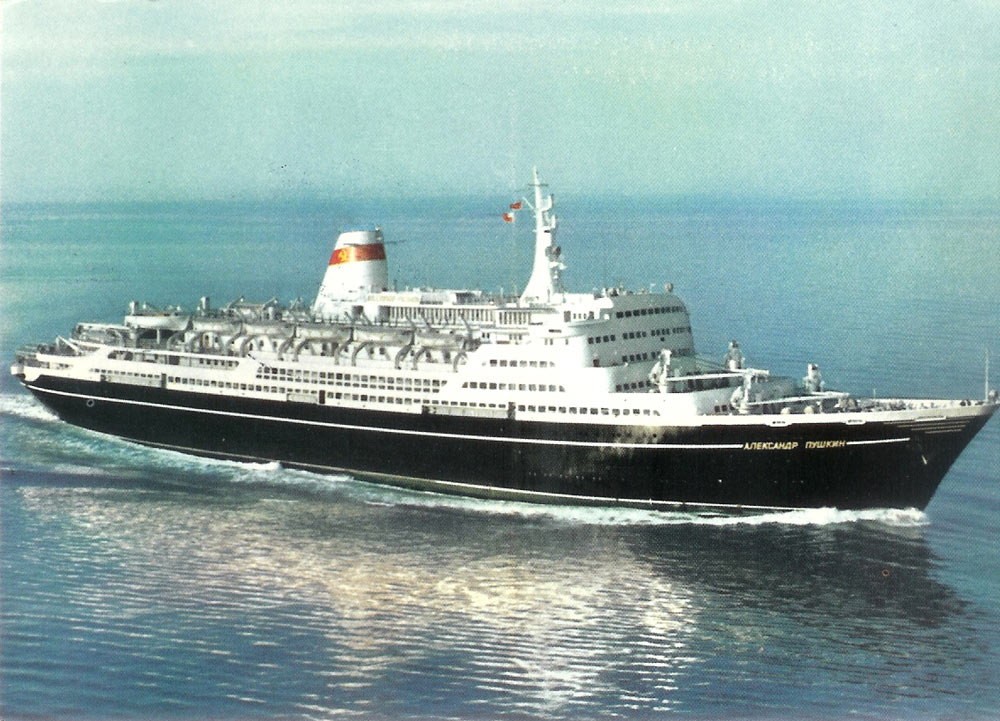
Originally the Alexandr Pushkin (and other ships of the Ivan Franko -class) were built with fairly unpretentious superstructures. The forward superstructure moderately streamlined, with the lowest superstructure decks terraced. The aft superstructure was similiarly terraced, with what looks like an observation longe between the bridge and the funnel and the decks neatly terraced immediately aft of the funnel (see for instance this postcard from Simplon Postcards). Already during the Soviet era the Alexandr Pushkin's forward superstructre was rebuilt into a more subtantial (and less attractive form). During the her time with the soviets the ship ran with a black hull decorated with a white riband and the usual Soviet funnel colours with white funnel decorated with a red stripe carrying the hammer-and-sicle -emblem. Many of the Alexandr Pushkin's sister recieved white hulls during their later Soviet career, but the Pushkin seems to have carried a black hull 'till the end.

Although the 1991-1993 refit which turned the ship into the Marco Polo left her superficially very similar to the original, closer inspection reveals her to have been radically altered. The large windows that originally adorned much of the superstructure have been replaced by smaller ones, the (presumed) observation lounge after of the bridge has been lost, and most importantly the aft superstructure has been radically extended, turning the originally fairly sleek ship into something much more boxy. Naturally the ship's livery was also altered in addition to the structural changes; the hull was now painted dark blue (without a decorative stripe) and the funnel white with a wide blue and a narrow red band.

The changes that have been made to the ship's exterior after she moved first to Transocean Tours and then to Cruise & Maritime Voyages have been largely marginal. Transocean Tours opted to keep the blue hull (though their other ship run with white hulls) but added a decorative stripe in two shades of turquise familiar from their other ships and naturally their own funnel colours. It also appears they lightened the shade of the hull slightly, though this might be just an optical illusion. Cruise & Maritime Voyages were content just to replace the Transocean Tours funnel symbol with their own.

The photographs below show the Marco Polo departing Helsinki's Länsisatama on 22 August 2008. Click on the individual images to view full size.

Shortly after departing the Hernesaari cruise quay. Why she used that quay is unknown to me; the better-located quays at Katajanokka she has normally used were free at the time as far as I remember.
For some reason, from this point of view and this livery the ship reminds me strongly of Lauro Line's first Angelina Lauro, despite the fact the hull colour is the only real similarity.
Pihlajasaari in the background on the right, as per the usual.
Passing Pihlajasaari slightly further on in quite nice wind (observe the bent trees on the island right of the ship's bow).
Not quite blending into the landscape. Not that a ship should either.
Further on, passing to the not-quite-so-calm waters of the Bay of Finland.