Superfast VIII
IMO 9198953
Built 2001, HDW Kiel, Germany
Tonnage 30 285 GT
Length 203,30 m
Width 25,42 m
Draught 6,60 m
Ice class 1 A Super
626 passengers
626 berths
661 cars
1 920 lane metres
4 Wärtsilä-Sulzer diesels, combined 46 000 kW
2 propellers
2 bow thrusters
1 stern thruster
Speed 28,9 knots
For the history of the Superfast VIII and her sisters, please refer to the previous entry about the Superfast VIII (incidentally, I would like to ask the Gods of Ship Photography why it's always the Superfast VIII that appears in a location where I'm photographing? I've got a grand total of zero pics about the Superfast VII but a huge pile of photos of the Superfast VIII).
In terms of design the Superfast VII though X series is a further development on the Superfast Ferries look first premiered on the Masa Yards -built sisters Superfast III and IV (now Transport of Tasmania's Spirit of Tasmania II and I, respectively). Personally I find that in terms of the exterior at least the VII-X series is the most attractive. All of the similar-looking III-XII ships are attractively sleek and streamlined in appearance, with pleasantly clean lines, but on the VII-X quartet this design is most effective thanks to their less extensive superstructures. In terms of the exterior the Superfast VIII and her sisters rank amongst my favourites amongst modern ships.
23 January 2011
Julia, 12 September 2008
Julia
IMO 8020642
Built 1982, AG Weser Seebeckswerft Bremerhaven, West Germany
Tonnage 22 161 GT
Length 153,40 m
Width 24,70 m
Draugth 5,80 m
Ice class 1A
2 048 passengers
863 berths
530 cars
4 Pielstick diesels, combined 15 300 kW
2 propellers
2 bow thrusters
Speed 20 knots
In the previous entry about the Julia I claimed those photos were my only pictures of that ship. It seems I was lying, as I discovered a handful of further photos I took on the same extended trip the two previous entries are also from. Nothing much else to say about the ship, so I guess it's straight to the photo.
| Julia at the Olympia terminal in Helsinki's Eteläsatama on 12 September 2008. The bow of Silja Serenade on the right. Click on the image to view full size. |
12 January 2011
Viking XPRS interiors, 14 September 2008
Viking XPRS
IMO 9375654
Built 2008, Aker Yards Helsinki, Finland
Tonnage 35 778 GT
Length 186,71 m
Width 27,70 m
Draft 6,75 m
Ice class 1A Super
2 500 passengers
732 berths
230 cars
1 000 lanemeters
4 Wärtsilä diesels, combined 40 000 kW
2 propellers
2 bow thrusters
1 stern thruster
Speed 25 knot
The Viking XPRS has, of course, been already widely covered in this blog, including the interiors. However, as previously noted her rear decks were rebuilt in early 2009 with the addition of a Dance Pavillion in place of a former outer deck area. Here are a few pictures from that area of the ship in the original construction, taken on 14 September 2008. Click on the individual images to view full size.
| The terraced rear deck in original configuration. Picture taken shortly after departing Helsinki, with Katajanokka in the background. |
| Looking forward from the aft of deck 7, towards Viking's Out. The superstructure was expanded aft-wards here when the Dance Pavillion was added. |
| "Inside" Viking's Out. Compare with the last three pictures in the Viking XPRS interiors 2009 -entry to get an idea how much the space has changed. |
11 January 2011
Galaxy, 13 September 2008
Galaxy
IMO 9333694
Built 2006, Aker Finnyards Rauma, Finland
Tonnage 48 915 GT
Length 212,10 m
Width 29,00 m
Draft 6,40 m
Ice class 1A Super
2 800 passengers
2 138 berths
420 cars
1 130 lanemeters
4 Wärtsilä diesels, combined 26 240 kW
2 propellers
2 bow thrusters
Speed 22 knots
Galaxy was the third newbuilding ever built for Tallink. She was based on the same construction as the company's two previous newbuilds Romantika and Victoria I, but with 20 metres added length. The ship's most notable exterior feature, the unusual livery, was designed by the Estonian naivist artist Navitrolla who is a personal friend of Tallink CEO Enn Pant. Navitrolla's work also carried on to the interior of the ship, where the staircases are adorned by his paintings (in my humble opinion the paintings in the interior work much much better than the exterior, where the practical demand of large fields of even colour takes away much of the adge of Navitrolla's style). Reportedly Enn Pant asked his friend to provide liveries of Tallink's subsequent newbuildings but the artist declined.
The Galaxy entered service on Tallink's Helsinki-Stockholm service in May 2006, replacing the Romantika. During the same month Tallink purchased the competing Silja Line and soon rumours begun flying that the Galaxy's then-under-construction sister ship would enter service not for Tallink but on Silja Line's Turku-Stockholm service. In the end when the new ship, eventually named Baltic Princess, entered service in July 2008 she replaced the Galaxy and it was the Galaxy that in turn moved to the Turku-Stockholm service, replacing the ageing Silja Festival.
In preparion for her new service the Galaxy was docked at Luonnonmaan telakka in Naantali and given a minor rebuild. At the same time her original Tallink Cruise hull markings were replaced by a Silja Line text. However, she retained her Tallink funnel symbol abd Silja Line's famous seal's head symbol was not painted anywhere on her hull or superstructure, making her the first major Silja Line ship since the company's formation in 1970 not to carry the seal. In marketing material the Galaxy has often been marketed as Silja Galaxy since the transfer. Her registered name however remains Galaxy.
The photographs below show the Galaxy in the Stockholm archipelago inbound to Stockholm in the afternoon of 13 September 2008. Photographed from onboard either Silja Serenade or Silja Symphony. Click on the image(s) to view full size.
| Not a bad-looking ship at all if you ask me. At least once the livery has had some time to grow on you. |
| Noticed the six-legged cow (yes, count them, six) and the giraffe with it's head above the clouds in addition to the penguins. |
10 January 2011
Marco Polo, 22 August 2008
Marco Polo
IMO 6417097
Built 1965, VEB Mathias-Thesen-Werft Wismar, East Germany
Tonnage 22 080 GT
Length 176,28 m
Width 23,55 m
Draught 8,17 m
915 passengers
2 Sulzer-Cegielski diesels, combined 15 447 kW
2 propellers
1 bow thruster
Speed 16,5 knots
Starting off the new year (somewhat belatedly I admit) with some of my favourite photographs from 2008, namely the Marco Polo's August visit to Helsinki's Länsisatama. New photographs from 2011 will fortcaming once the weather is cooperative with my plan of photographing the local ferries in the ice (ice is not a problem but the lack of good light is).
The service history of the Marco Polo has already been covered in the previous entry about her (him?). This time I will instead be looking at how the ship's exterior has changed over the years.
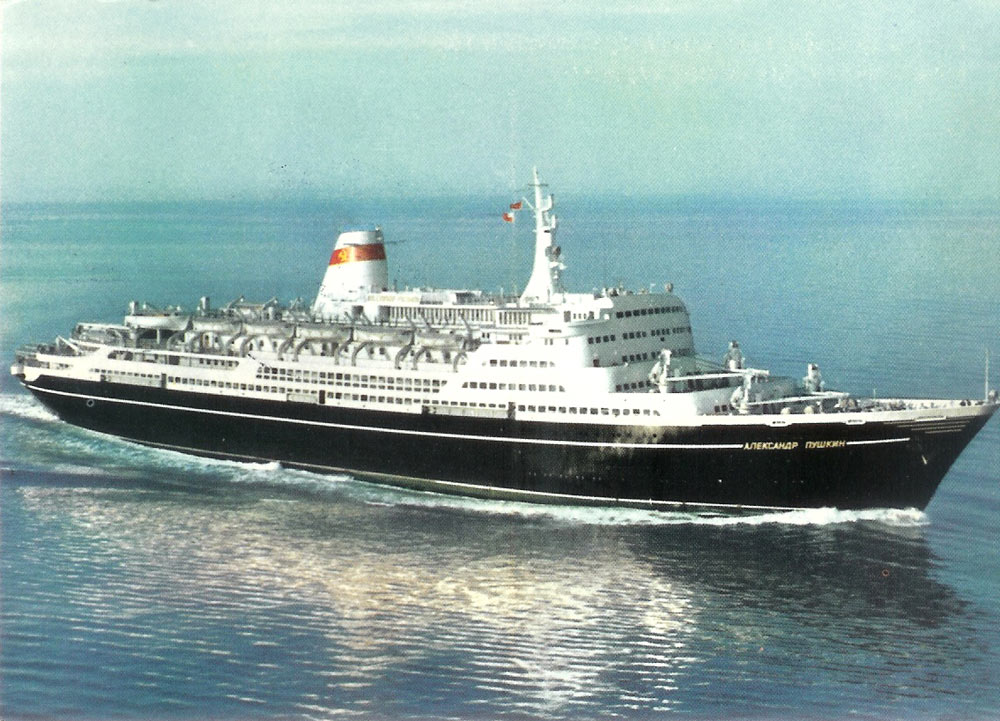
Originally the Alexandr Pushkin (and other ships of the Ivan Franko -class) were built with fairly unpretentious superstructures. The forward superstructure moderately streamlined, with the lowest superstructure decks terraced. The aft superstructure was similiarly terraced, with what looks like an observation longe between the bridge and the funnel and the decks neatly terraced immediately aft of the funnel (see for instance this postcard from Simplon Postcards). Already during the Soviet era the Alexandr Pushkin's forward superstructre was rebuilt into a more subtantial (and less attractive form). During the her time with the soviets the ship ran with a black hull decorated with a white riband and the usual Soviet funnel colours with white funnel decorated with a red stripe carrying the hammer-and-sicle -emblem. Many of the Alexandr Pushkin's sister recieved white hulls during their later Soviet career, but the Pushkin seems to have carried a black hull 'till the end.
Although the 1991-1993 refit which turned the ship into the Marco Polo left her superficially very similar to the original, closer inspection reveals her to have been radically altered. The large windows that originally adorned much of the superstructure have been replaced by smaller ones, the (presumed) observation lounge after of the bridge has been lost, and most importantly the aft superstructure has been radically extended, turning the originally fairly sleek ship into something much more boxy. Naturally the ship's livery was also altered in addition to the structural changes; the hull was now painted dark blue (without a decorative stripe) and the funnel white with a wide blue and a narrow red band.
The changes that have been made to the ship's exterior after she moved first to Transocean Tours and then to Cruise & Maritime Voyages have been largely marginal. Transocean Tours opted to keep the blue hull (though their other ship run with white hulls) but added a decorative stripe in two shades of turquise familiar from their other ships and naturally their own funnel colours. It also appears they lightened the shade of the hull slightly, though this might be just an optical illusion. Cruise & Maritime Voyages were content just to replace the Transocean Tours funnel symbol with their own.
The photographs below show the Marco Polo departing Helsinki's Länsisatama on 22 August 2008. Click on the individual images to view full size.
![]() |
| Shortly after departing the Hernesaari cruise quay. Why she used that quay is unknown to me; the better-located quays at Katajanokka she has normally used were free at the time as far as I remember. |
![]() |
| For some reason, from this point of view and this livery the ship reminds me strongly of Lauro Line's first Angelina Lauro, despite the fact the hull colour is the only real similarity. |
![]() |
| Pihlajasaari in the background on the right, as per the usual. |
![]() |
| Passing Pihlajasaari slightly further on in quite nice wind (observe the bent trees on the island right of the ship's bow). |
![]() |
| Not quite blending into the landscape. Not that a ship should either. |
![]() |
| Further on, passing to the not-quite-so-calm waters of the Bay of Finland. |
Subscribe to:
Posts (Atom)